← Overview · Deutsch · Ελληνικά · Sources
Law and governance
Not legal advice. Classification requires a joint opinion by qualified Greek and EU monetary, banking, tax, data-protection and crypto-asset counsel.
Three legal situations must not be mixed
Category A — Phase 0 inside the euro area
The proposed scope is research, simulation, a valueless testnet, security work and cash-process experiments without nominal value. There is no mandatory acceptance, tax acceptance, wage payment or state-backed ΔΡΑΧ value.
A later voluntary value-bearing pilot would require prior analysis of MiCA classification, whitepaper duties, CASP authorisation, AML/Travel Rule, privacy, tax and consumer protection. The study does not claim a final MiCA classification.
Category B — voluntary complementary use
Voluntary use for selected fees, vouchers or contracts could be examined. The more the state uses taxes, salaries or public procurement to create compulsory ΔΡΑΧ demand, the more the arrangement resembles a parallel currency with monetary character. This is legally and politically sensitive and outside Phase 0.
Category C — full monetary sovereignty
Legal tender, tax denomination, national notes and mandatory acceptance would require a separate fundamental decision on monetary sovereignty. Target2, banks, deposit insurance, euro debt, contracts, capital controls, cash logistics and international agreements would have to be addressed. The dossier outlines the questions but does not recommend leaving the euro area.
Why the euro boundary remains explicit
Article 128 TFEU gives euro banknotes legal-tender status; Regulation 974/98 governs the introduction and use of the euro in participating Member States. This does not mean every voluntary digital unit of account is automatically prohibited. It does mean a second national legal tender cannot be introduced in the euro area by a technology project alone.
MiCA and Greece
MiCA has applied in full since 30 December 2024. Greek Law 5193/2025 specifies national competent authorities, legal forms, measures and penalties. Whether a non-pegged, state-started and later decentralised asset would be an ART, another crypto-asset or outside parts of MiCA remains an open legal question. Offering, custody, exchange and operation may trigger different duties.
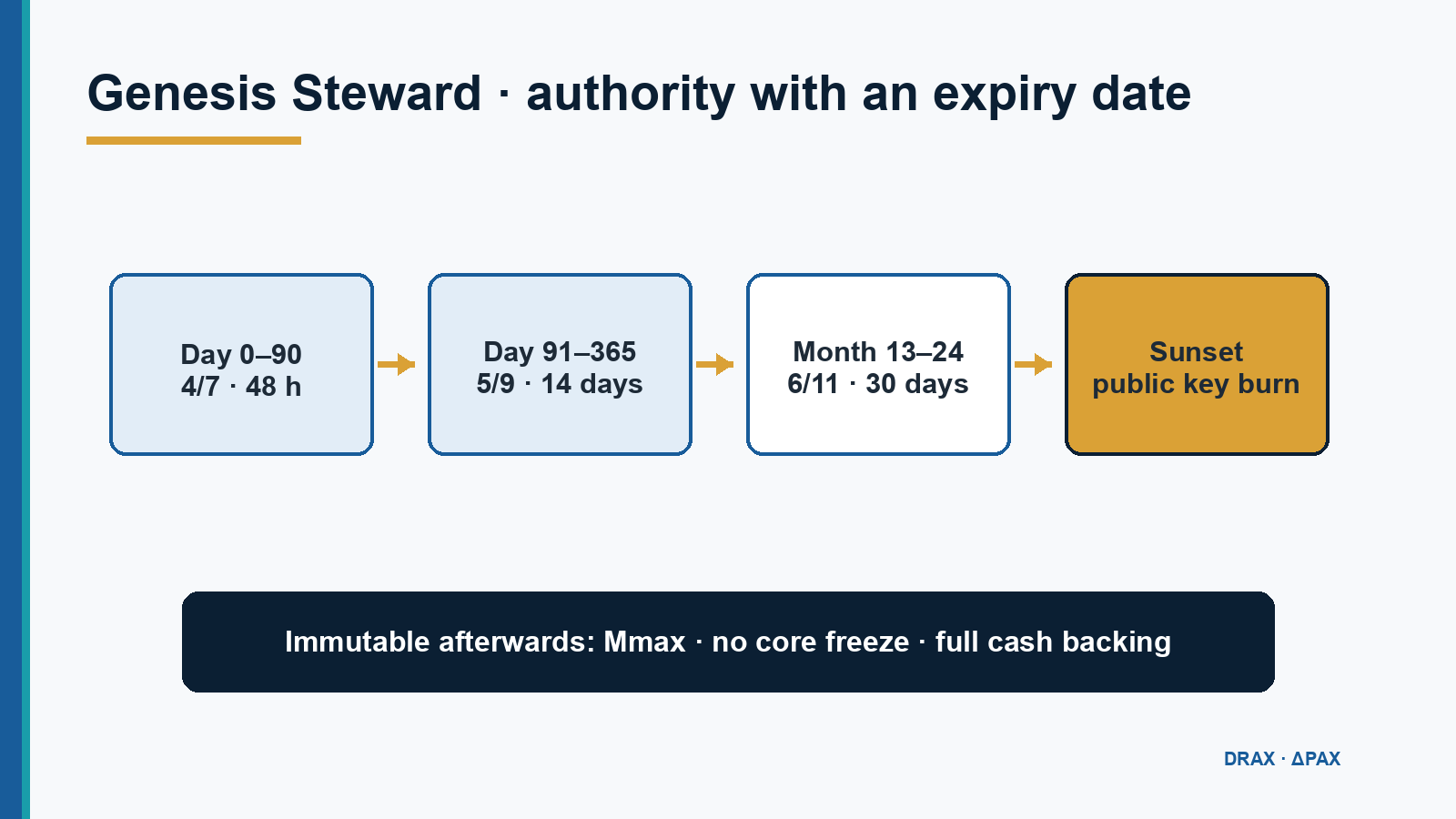
Genesis Steward
| Period | Remaining authority | Control |
|---|---|---|
| Day 0–90 | testnet deployment and bug fixes | 4/7, 48-hour timelock |
| Day 91–365 | security-critical changes only | 5/9, 14 days |
| Month 13–24 | handover, no new economics | 6/11, 30 days |
| Sunset | public key burn | reproducible covenant proof |
These are planning parameters. After sunset, no ministry, bank or token majority should be able to alter Mmax, the lack of a freeze function or the cash-backing rule. Law can still regulate use and intermediaries; technology does not abolish state power.
Governance after sunset
Governance may propose parameters at the edges, such as fee guidance, indexer lists or risk reports. It must not gain a global pause switch, blacklist, new mint authority or the ability to extend the Genesis mandate. Every residual governance power is a potential capture point.